miguelcovarrubias
Pageant of the Pacific: Miguel Covarrubias’s Representations of Pacific Culture at the 1939 San Francisco World’s Fair
By Anna Rohl
In 1939, San Francisco hosted the Golden Gate International Exposition, a World’s Fair whose theme was “Pageant of the Pacific.” The goal of the fair was to promote unity and trade between nations all around the Pacific Ocean. The fair took place on Treasure Island, a 576-acre man-made island in San Francisco Bay constructed for the express purpose of being San Francisco’s fairgrounds.
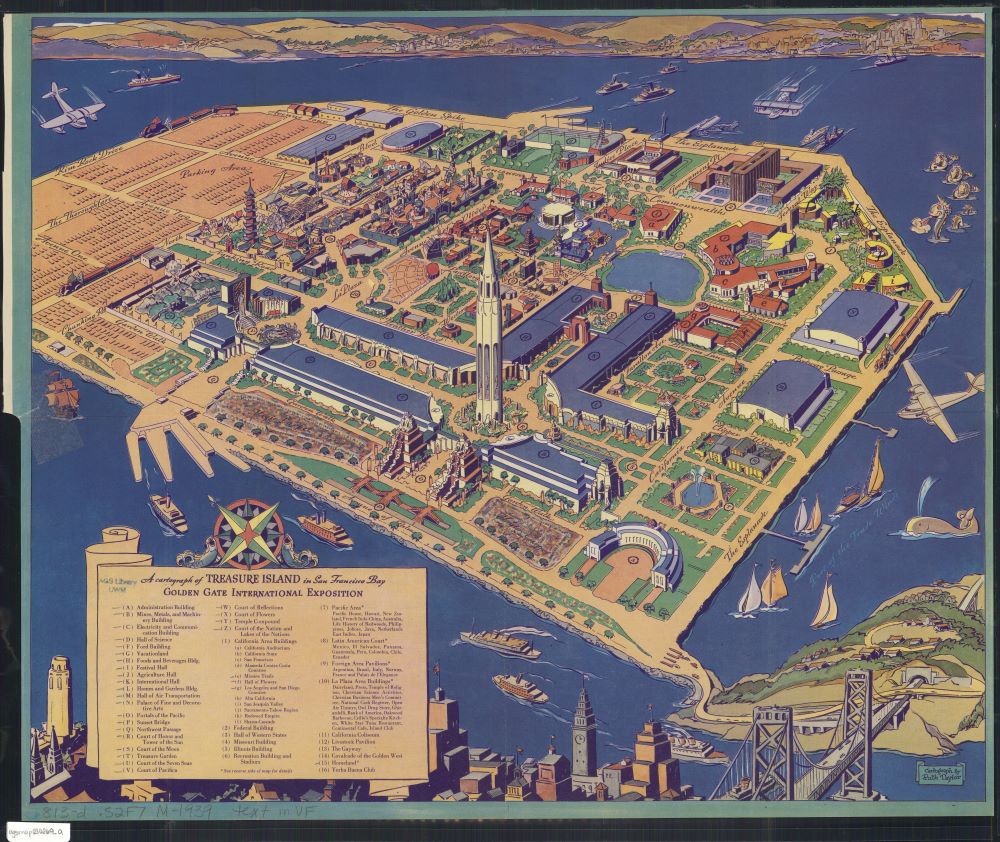
While the island was packed with classic World’s Fair attractions— from monumental architecture to industry innovations to the carnival area called the “Gayway”–the center of the fair was a building called the Pacific House. This building “dramatiz[ed] the common interests of the peoples of the Pacific Hemisphere and demonstrat[ed] their contributions to contemporary civilization,” according to the Official guidebook of the fair (Tilden 79). Pacific House presented this vision of unity through a variety of maps and displays, but the most famous were the six Pageant of the Pacific murals made by the Mexican artist Miguel Covarrubias.
Covarrubias (1904-1957) made a name for himself in the international art world after he moved from Mexico City to New York City in 1923. His artistic work spanned several mediums, from illustrating magazine covers to designing theater sets. However, Covarrubias was also interested in ethnography and anthropology, and as his career progressed, writing books about Indigenous Central American and South East Asian cultures became what some scholars consider to be his “life’s work” (Racine 168). Covarrubias brought this breadth of knowledge and experience to the Pageant of the Pacific murals, which have been widely admired by artists, anthropologists, and historians ever since they debuted at the fair in 1939.
These six murals were (and continue to be) notable in a number of ways. First, Covarubbias’s choice to use a base map centered on the Pacific which excluded Europe was, at the time, still a remarkable idea to many Westerners. He worked with Carl Sauer—an influential geographer who advocated for studying human choice in geography, not just environmental influences on culture—to choose the van der Grinten projection for the map, because it would minimally distort the size of the regions depicted (Racine 164).
The murals were also remarkable because of Covarrubias’s knowledge of ethnography and anthropology. Unlike most western world’s fair exhibits, the Pageant of the Pacific murals present the wide variety of cultures they depict as equals, all worthy of interest and celebration. They also stress connections between cultures and across space, and even across time, rather than stressing cultural difference or hierarchies by othering non-white cultures. As a scholar of pre-Columbian Mexican cultures, Covarrubias actively sought to de-center white, colonial influences in the Pacific through his choices of content and design ((Lutkehaus 117). In these murals, the people and creations of tribal and ethnic groups across four continents are presented as equally important, interesting, and dignified. Covarubbias’s non-narrative murals invited fairgoers to make connections between the regions and cultures depicted, rather separating them based on differences (Racine 172-173).
Read on to learn a little more about each of the six murals and look at Covarrubias’s innovative and beautiful work!
A Close-Up Look at Each Mural:
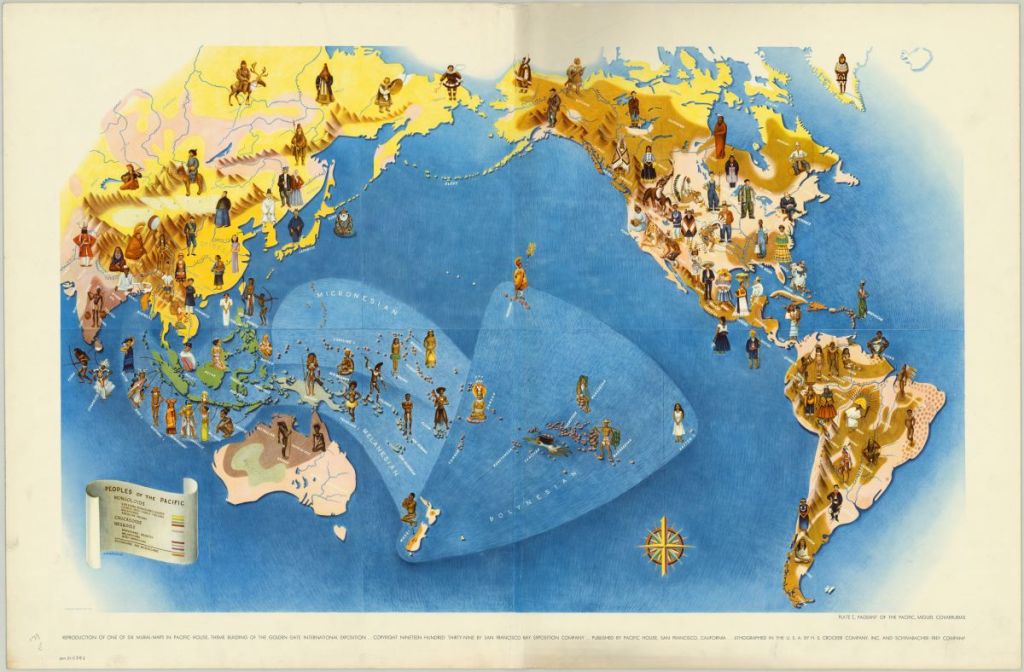
Covarrubias’s interest in ethnography is most clearly visible in the first of his murals, titled “Peoples of the Pacific.” This mural includes detailed depictions of figures from across Eastern Asia, Oceania, and North and South America, often in traditional grab, but in some cases (like the cigar-smoking businessman in a suit placed near New York City) the people depicted are more contemporary. This is likely the mural which Covarrubias spent the most time researching. He not only integrated his own ethnological research on Indigenous, pre-Columbian cultures in Central and South America, but also consulted with various leading anthropologists of the time in deciding which cultures to depict and how (Lutkehaus 124).
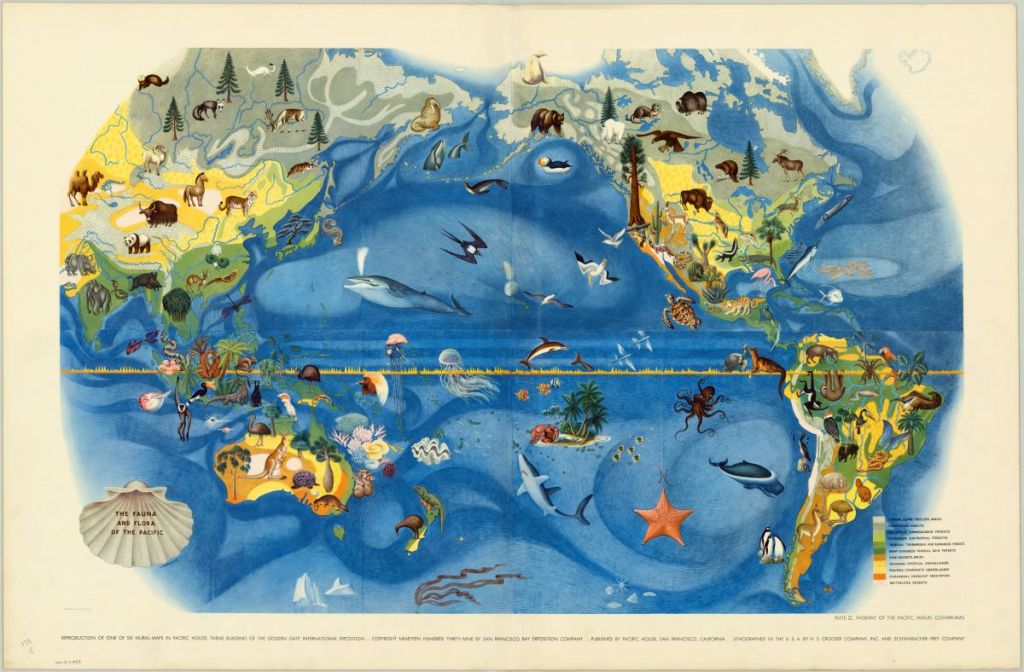
Next is Covarrubias’s depiction of the “Flora and Fauna of the Pacific.” While the full ecological vibrancy of this part of the world is not fully captured in the mural, the piece does capture the variety of creatures, trees, aquatic critters, and insects which can be found in and around the Pacific.
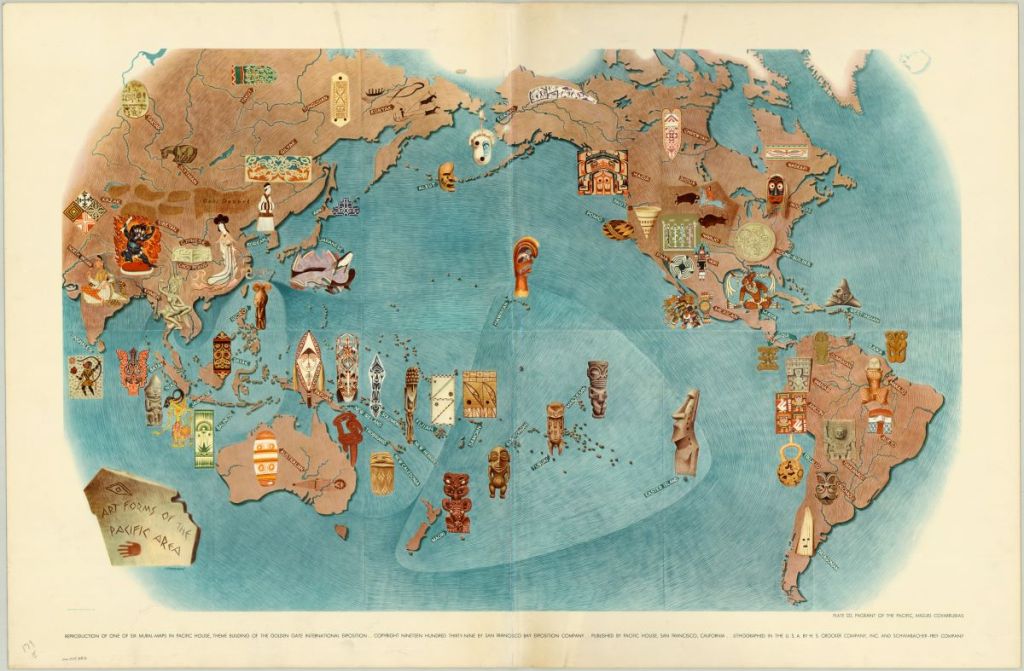
The third mural is titled “Art Forms of the Pacific,” and once again shows Covarrubias’s interest in human cultures. Like the costumes in the first mural, the art forms included range from ancient to contemporary, inviting viewers to make connections between different Pacific regions’ art forms over both space and time (Covarrubias 10). Covarubbias’s attention to highly researched detail is even more evident in the essays he published in 1940 to accompany lithographic prints of the murals. The essay on “Art Forms of the Pacific” is the longest of the six, with nearly 4 pages dedicated to explaining each art form and culture depicted.
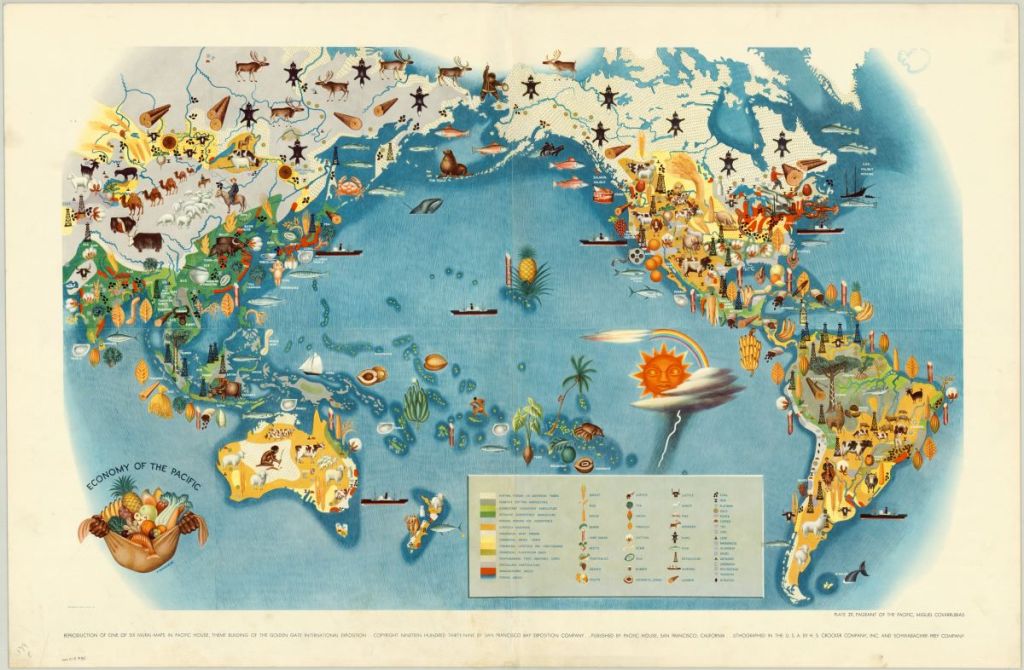
Fourth is “The Economy of the Pacific,” perhaps the most colorful and information-dense of the six murals. Here, Covarubbias has added color to his base map to indicate the predominant industry of each region around the Pacific and then added drawings of the particular products farmed, harvested, or manufactured in different spots. While he includes a legend, items included in the mural are often customized to their region. For example, each of Covarubbias’s cattle reflects the unique traits of their region’s livestock, instead of being depicted by just one generic cow symbol. One also gets the sense that Covarrubias couldn’t separate the products produced and harvested around the Pacific from the people who did that work: depictions of men fishing, logging, herding and crafting are scattered across the mural.
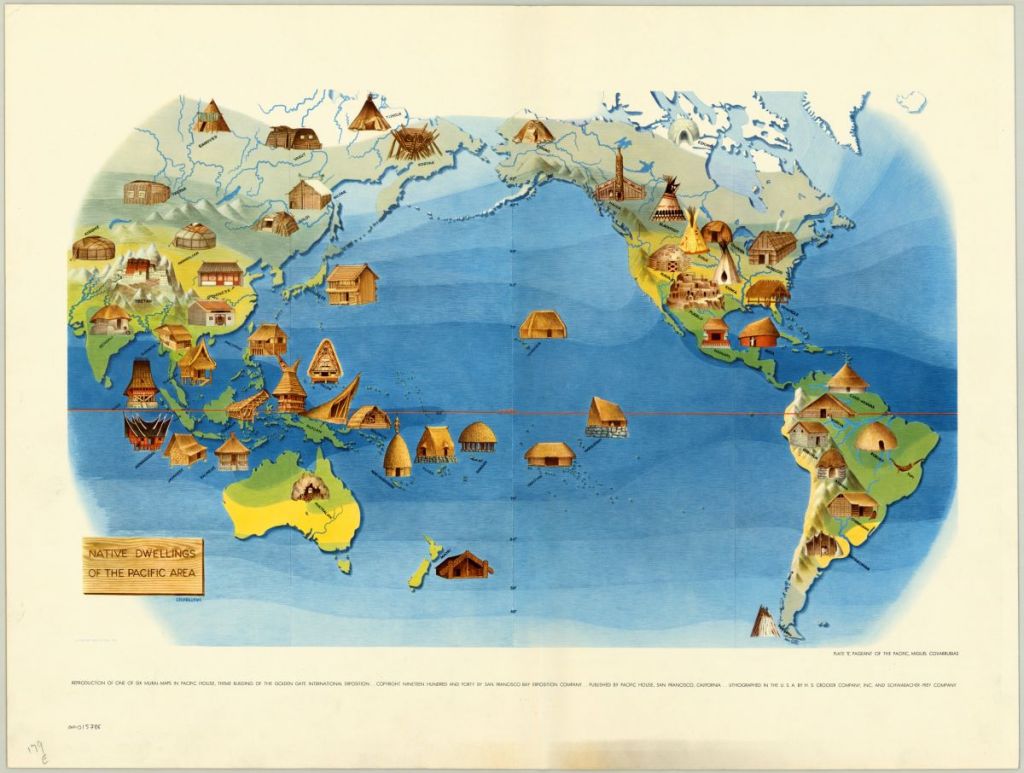
The next mural is “Native Dwellings of the Pacific Area,” another opportunity for Covarubbias to celebrate various ethnic groups’ work and lifestyles. In the essays accompanying the prints of the murals, Covarubbias pays careful attention to the tribes and ethnic groups to whom the traditional homes he represents belong. He also emphasizes how similar styles of dwellings span the Pacific, coinciding nicely with the fair’s theme of Pacific unity. To name just one example, he notes that a style of “flat-roofed house generally of adobe or mud… is characteristic of Northern India or Tibet, [but] mysteriously reappears in North America, in New Mexico and Arizona among the Pueblo Indians and in Northern Mexico.” (Covarrubias 17).
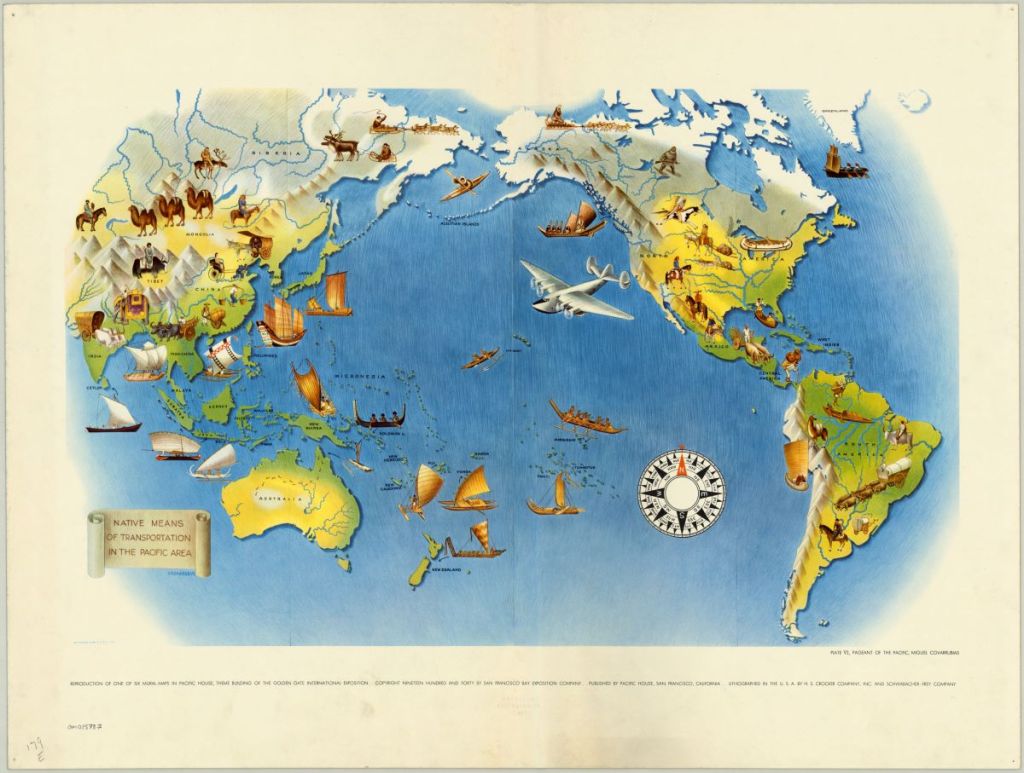
The final mural in the series is “Native Means of Transportation, Pacific Area.” In the accompanying text, Covarrubias notes that the modes of transportation developed by the peoples of the Pacific area are creative and diverse by necessity, since after all the Pacific region includes “such vast expanses of ocean, of forests, and plains… great rivers and lakes… [and] some of the highest mountain ranges in the world and the most impassable jungles and desserts.” (Covarrubias 18). While most of the means of transportation are traditional, the one exception is the airplane which seems to be setting off across the ocean from San Fransico. The choice to include this modern transportation technology was likely rooted in the fact that fair officials intended to transform Treasure Island into an airport after the fair was over, ushering in a new age of travel from the US into Asia and the Pacific (Lutkehaus 111). Unfortunately, this vision for the island (and of Pacific peace and unity) was disrupted by WWII: Treasure Island was transformed into an Airforce base, rather than a passenger airport.
Can’t get enough of these murals? If you’d like to see prints of the Pageant of the Pacific murals in person, come and view them here at the AGSL! You can also view them up close in our digital collection. And if you’d like to see Covarrubias’s work in person, “Flora and Fauna of the Pacific” is displayed at the De Young Museum in San Francisco, the only one of the six murals available for the public to see today.
Works Cited:
Covarrubias, Miguel. Pageant of the Pacific. San Francisco: Pacific House, 1940. Available online through HathiTrust https://babel.hathitrust.org/cgi/pt?id=uc1.c085623706&seq=1
Creason, Glen. “L.A. Stories From the Map Cave: Pageant of the Pacific.” LAPL Blog. 17 May, 2017. https://www.lapl.org/collections-resources/blogs/lapl/pageant-pacific
“The Golden Gate International Exposition, 1939-1940.” You Are Here: The Story of Treasure Island. Treasure Island Museum. Accessed 16 October 2023. https://www.treasureislandmuseum.org/youarehere/the-golden-gate-international-exposition
Lutkehaus, Nancy C. “The Pageant of the Pacific: Miguel Covarrubias and the Golden Gate International Exposition 1939-1940.” In Transpacific Studies: Framing an Emerging Field, edited by Janet Hoskins and Viet Thanh Nguyen, 109-133. Honolulu: University of Hawai’I Press, 2014.
Racine, Nathaniel R. “Mapping Miguel Covarrubias Across Cultures and Disciplines.” Review of International American Studies Vol. 13, No. 2 (Fall/Winter 2020): 159-183.
Rydell, Robert W., John E. Findling, and Kimberly D. Pelle. Fair America: World’s Fairs in the United States. Washington D.C: Smithsonian Institution Press, 2000.
Tilden, Gladys, editor. Official Guide Book: Golden Gate International Exposition on San Francisco Bay, Revised Edition. San Francisco: Golden Gate International Exposition, 1939.

