China
Splendid China was abandoned, looted, turned to rubble and transformed into Margaritaville
by Angie Cope
I’ve been working from home cataloging maps that were donated to the AGS Library. I thought I’d be able perform this task very quickly but, every other map I encounter seems more interesting than the last and distracts me. Today I ran across one called “Splendid China.”
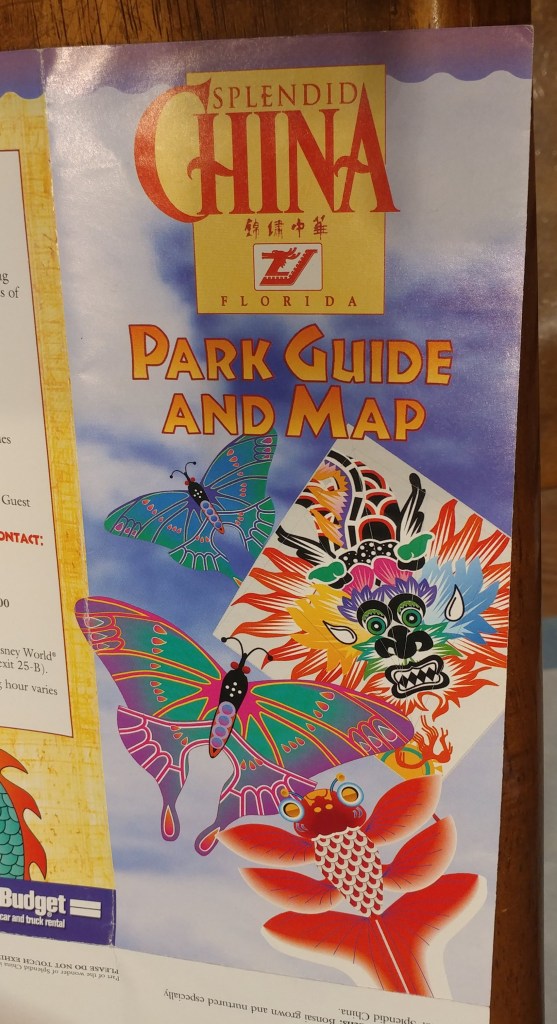
Splendid China was a theme park in Florida near Walt Disney World. The park opened in 1993, and closed on December 31, 2003. Splendid China, Florida had a sister park in Shenzhen, China which remains open today.
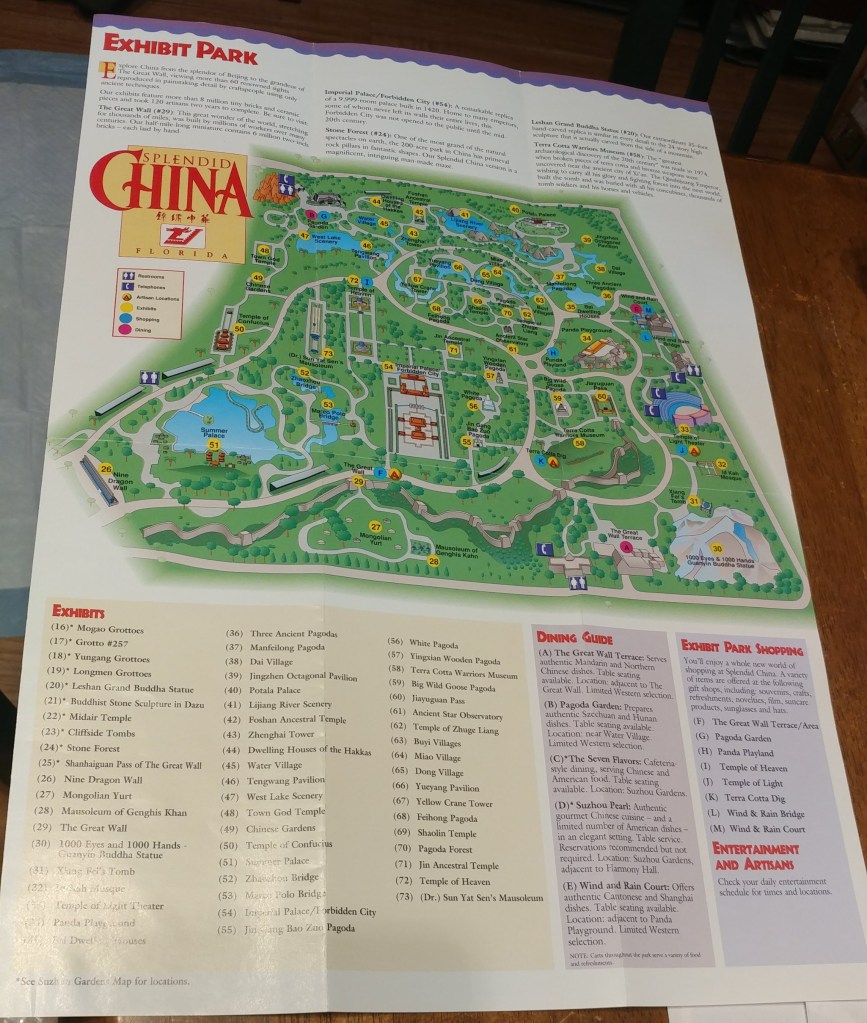
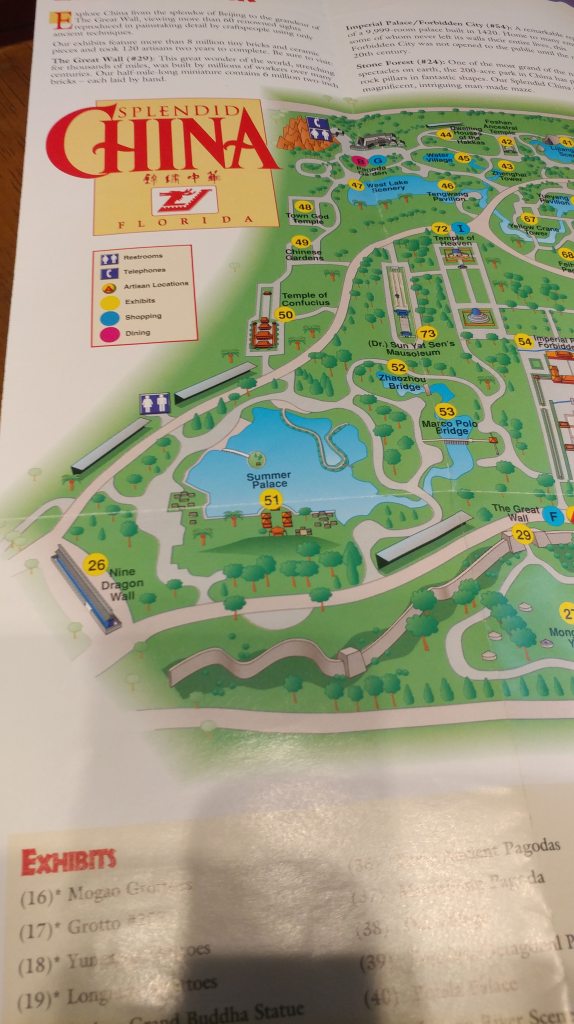
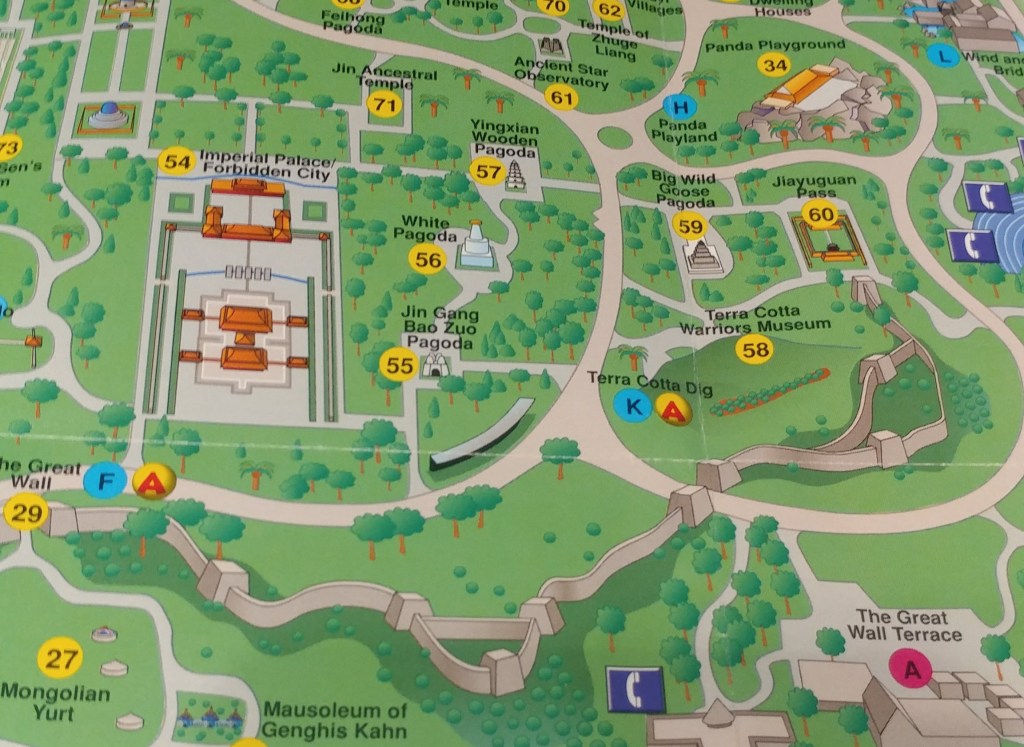
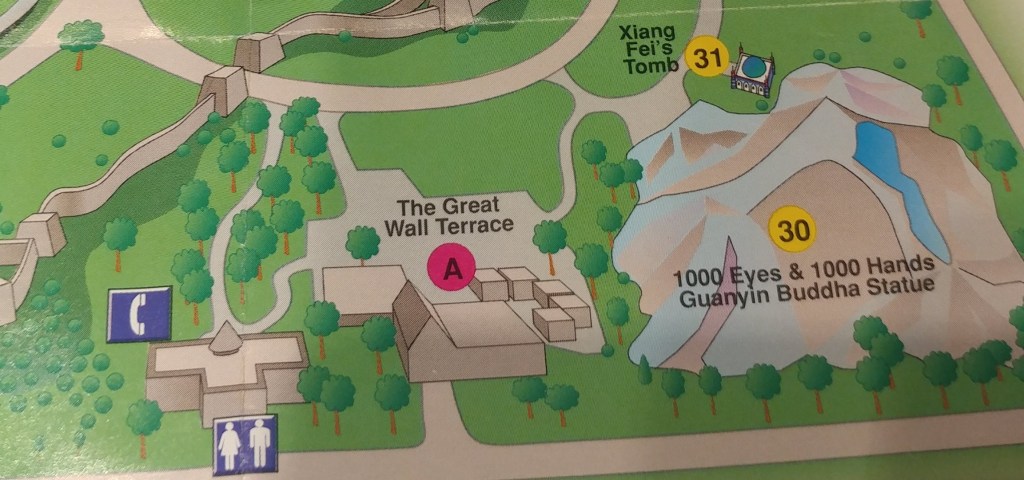
The Florida park contained over 60 one tenth scale detailed replicas of China’s most famous landmarks such as the Great Wall, Forbidden City, and the Terra Cotta Warriors. After years of controversy and protests, the park closed in 2003, vandals looted what wasn’t nailed down and the park was reduced to rubble.
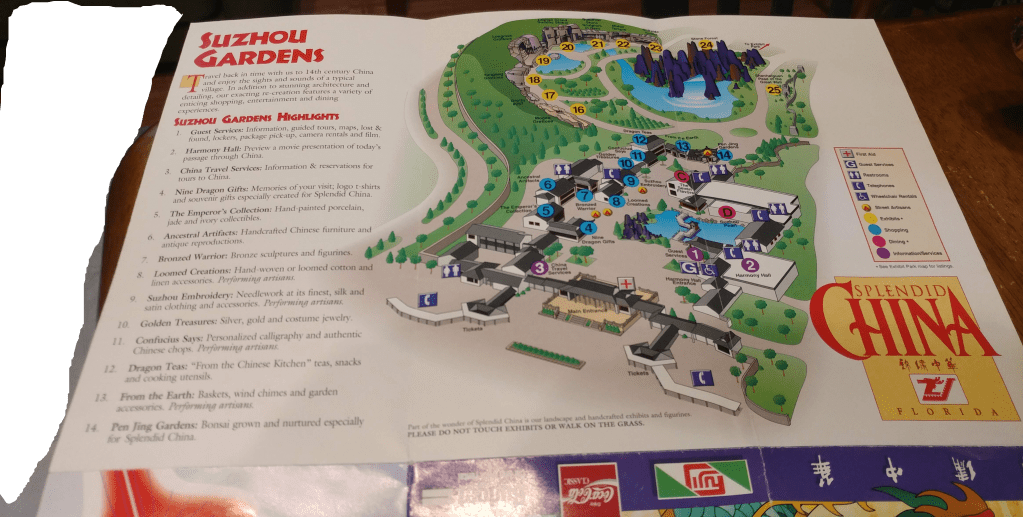
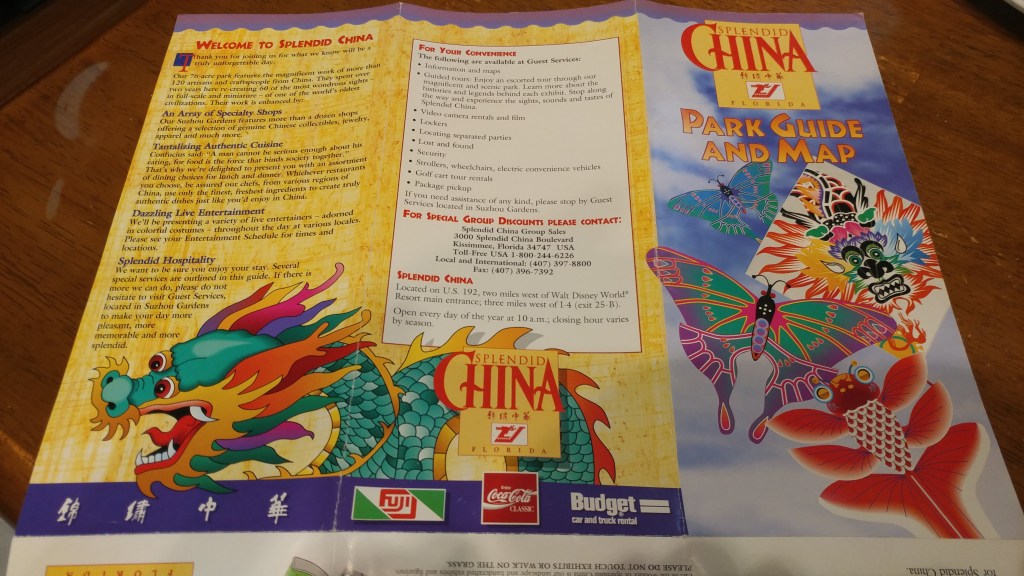
In 2018 the site was officially cleared, making way for the American resort Margaritaville that opened in 2018.
Read more about Splendid China, Florida
Atlas Obscura: https://www.atlasobscura.com/places/splendid-china-orlando
Wikipedia: https://en.wikipedia.org/wiki/Splendid_China_(Florida)
Roadside America: https://www.roadsideamerica.com/story/2057
The Case of Turpan, China: How to Destroy a Culture
by Don Hanlon, Emeritus Professor of Architecture, UW-Milwaukee
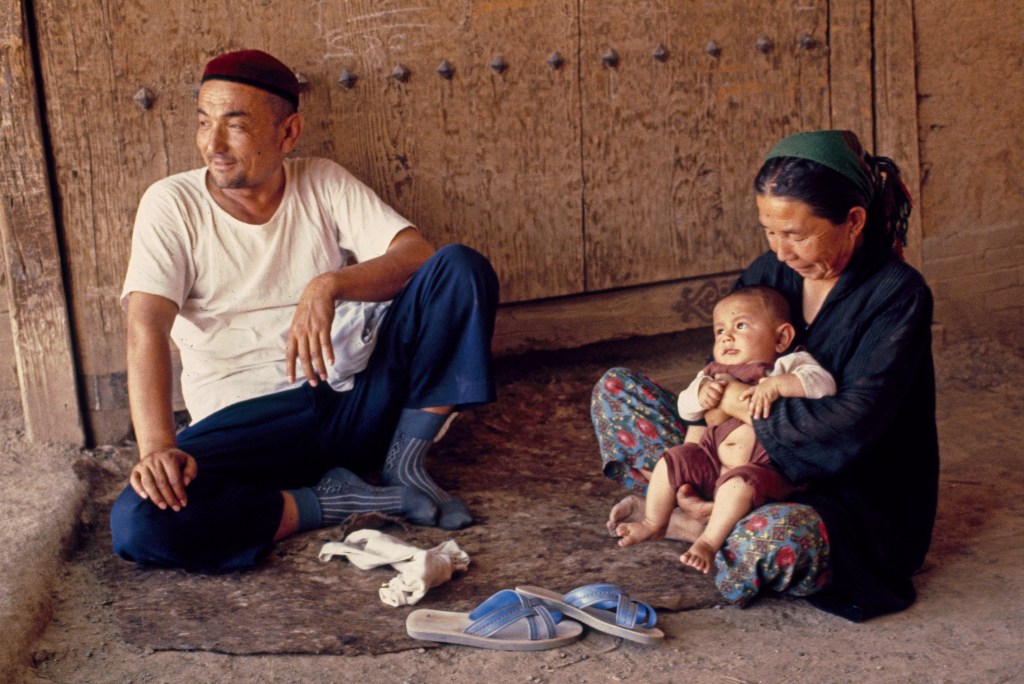
In 1987, I conducted a survey of vernacular architecture in the oasis of Turpan in Xinjiang Province, in the far west of the Peoples Republic of China. The project was funded by the United Nations Development Program in response to my initial report to the UNDP in 1985 that this ancient architectural tradition was being systematically destroyed as part of a vigorous effort by the Chinese government to eradicate the indigenous culture of the Uighur people. The Uighur have lived in Turpan continuously for over 1100 years. My role was to document, in photographs and drawings, the architecture of the town as it related to Uighur social customs and other aspects of culture before they were annihilated. As of this writing, the Chinese government has demolished all of the Uighur domestic and religious architecture in Turpan except for a few examples preserved as tourist attractions.
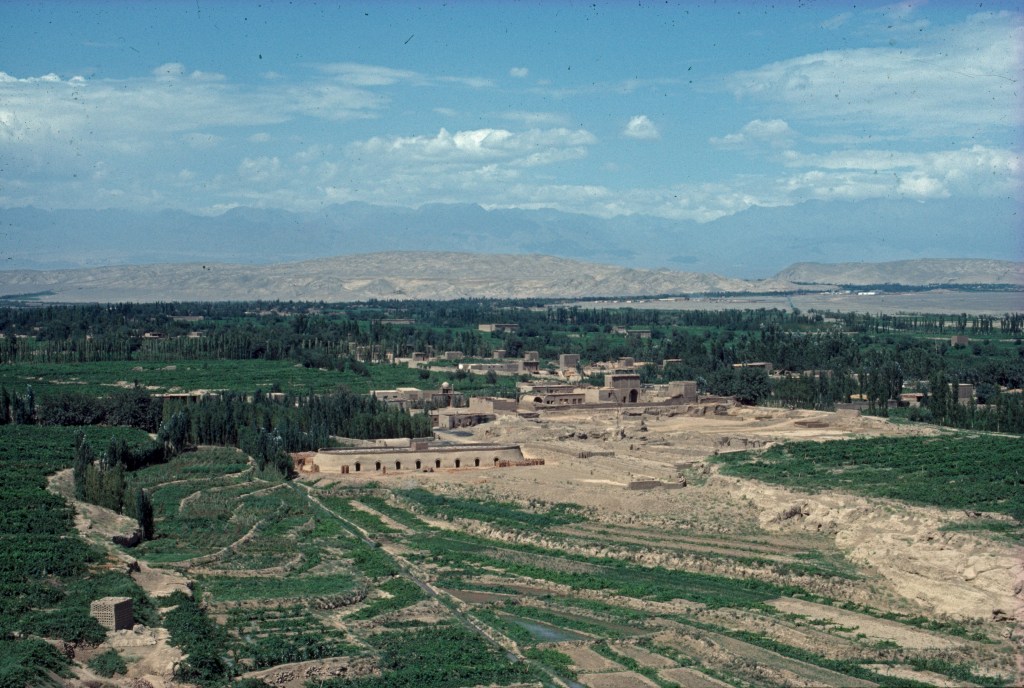
For centuries, Turpan was an important node on the Silk Road for merchants traversing the hostile Taklamakan desert in central Asia. The Uighur were originally a powerful Turkic-speaking tribe which over time absorbed cultural influences from the many different people who passed through their domain. For example, important architectural characteristics, music and dance show strong influences from Persia and the region of central Asia to the west known as Transoxiana, an area that was home to the great cities of the Mongol empire, such as Samarkand and Bukhara. The Uighur practice a form of Sunni Islam, but due to their heterogeneous population, religious practice and Islamic social conventions are moderate and tolerant.
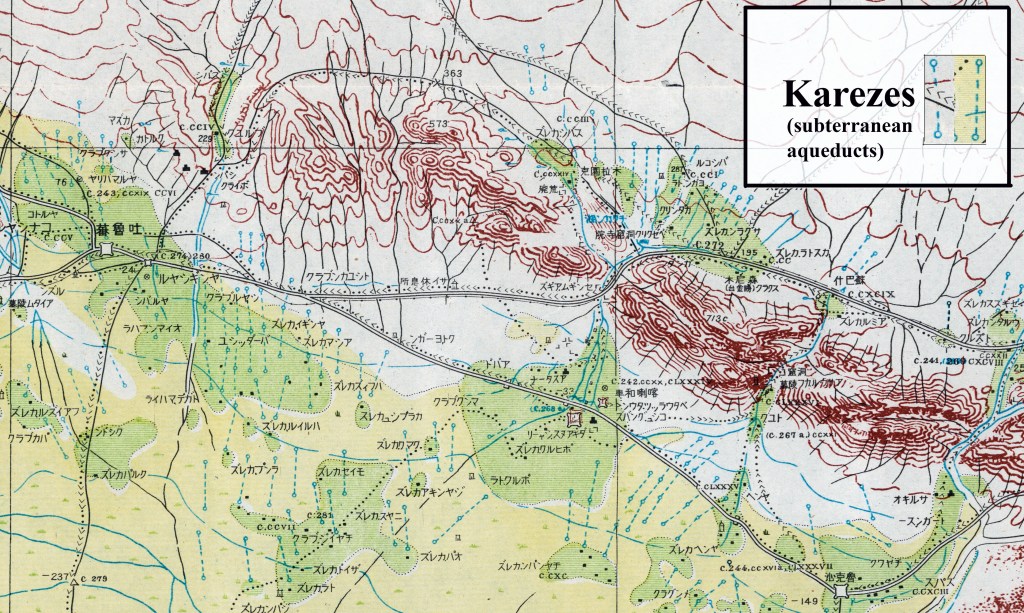
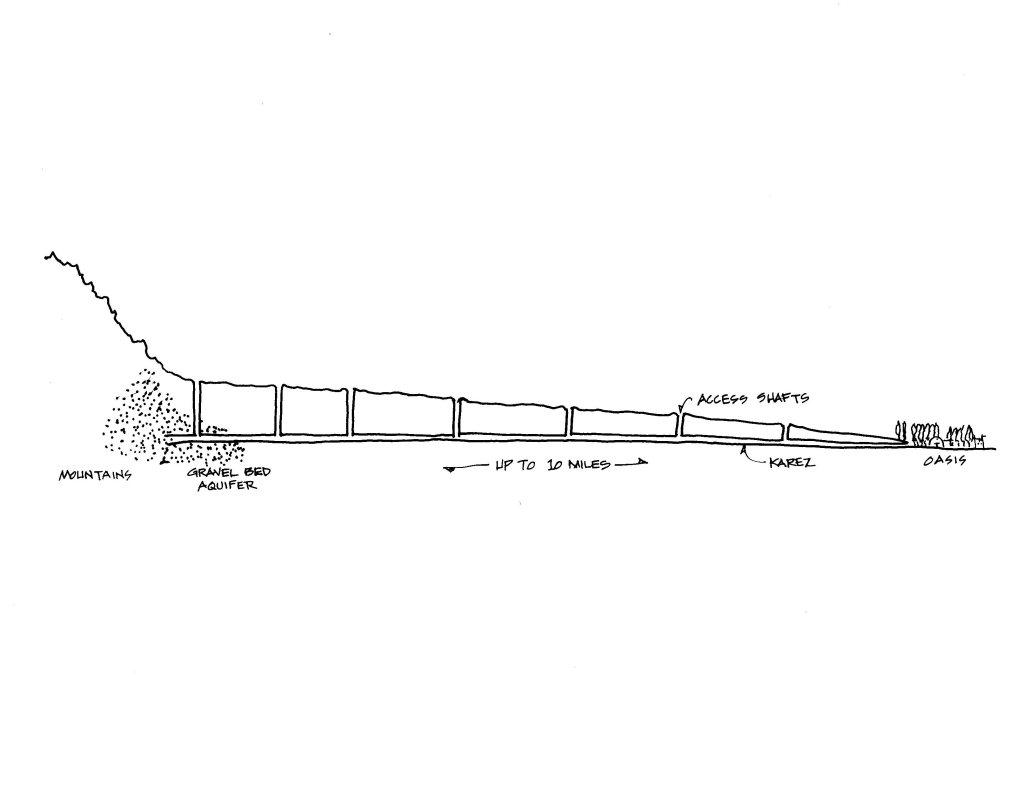
Despite a harsh climate of extreme heat and zero rainfall, trade and agriculture in Turpan have thrived due to an innovative hydrological innovation imported many centuries ago from Persia. This is the system of kareze which are subterranean aqueducts that bring water to the oasis from the foothills of the Tian Shan mountain range to the north. The kareze are tunnels dug far below the desert surface, carefully engineered to maintain a constant shallow slope to prevent erosion. Thus, Turpan enjoys clean, cold water year-round for both domestic and agricultural use. A 1943 map of Turpan by a Japanese spy shows the kareze as dotted lines (courtesy of the American Geographical Society Library).
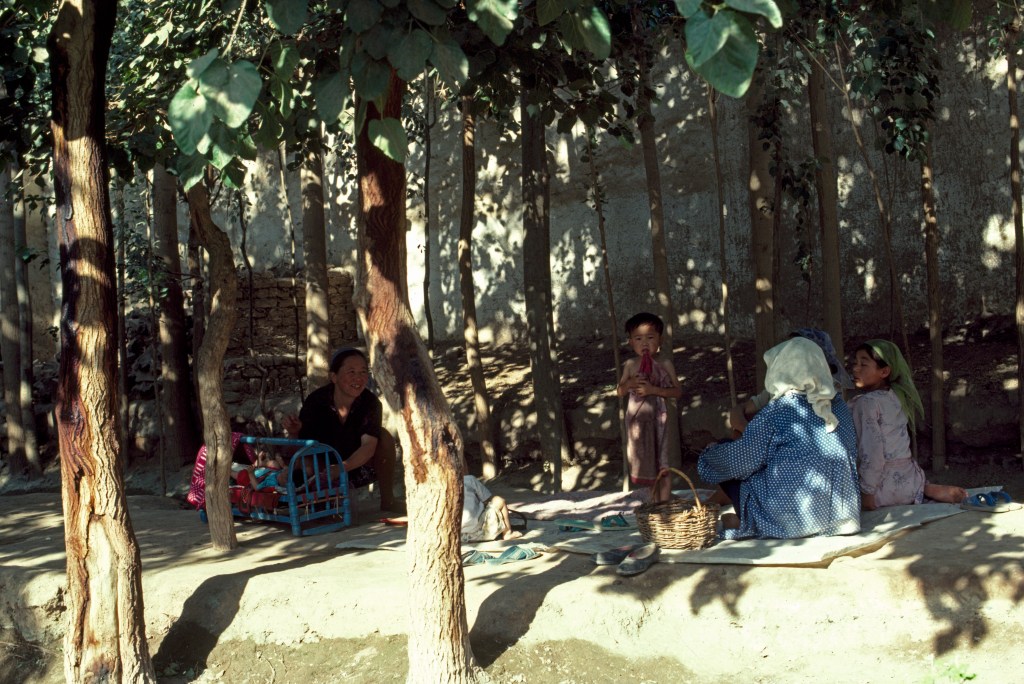
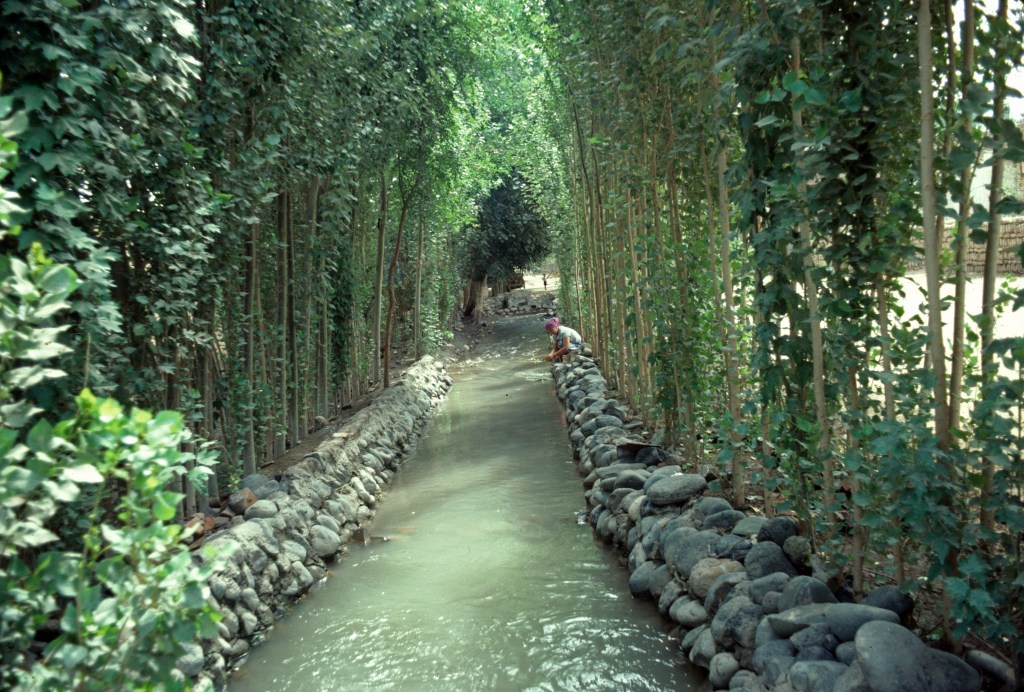
The kareze open into a system of canals in the town that form the boundaries between streets and residences. Tall, straight poplars grow in tight rows directly out of the canals. These perform several important functions: they provide deep shade for the houses and for the street; they create a wind break to control dust; they provide wood readily available for construction and heating; and they create a microclimate in the street by transpiring water through their leaves into the air, producing a natural means of air conditioning that can lower the temperature in the street and adjacent houses by as much as 20 degrees Fahrenheit. After circulating through the town entirely by gravity, water then enters into second system of canals for irrigating agriculture. All of this is accomplished without any mechanical devices or artificial sources of energy – a truly sustainable method.
My study included two types of architecture under threat – houses and mosques. The house form in use in Turpan for many centuries was typical of vernacular houses we find in an arc from Morocco, across north Africa, the Middle East to central Asia. It organizes all domestic spaces around a central courtyard, which functions as the main living space of the house. This design is a highly efficient, sustainable building form, perfectly suited to a hot, dry climate without using any mechanical means to artificially heat or cool. The house operates on a diurnal cycle. At night, cool air settles in the courtyard while heat captured during the day in the thick surrounding walls radiates into the night air. During daylight, the gradually heating mass of the house draws the cool air of the courtyard into surrounding interior spaces. In Turpan, a thick grape arbor over the courtyard enhanced this passive cooling system by breaking direct sunlight while allowing the passage of air.
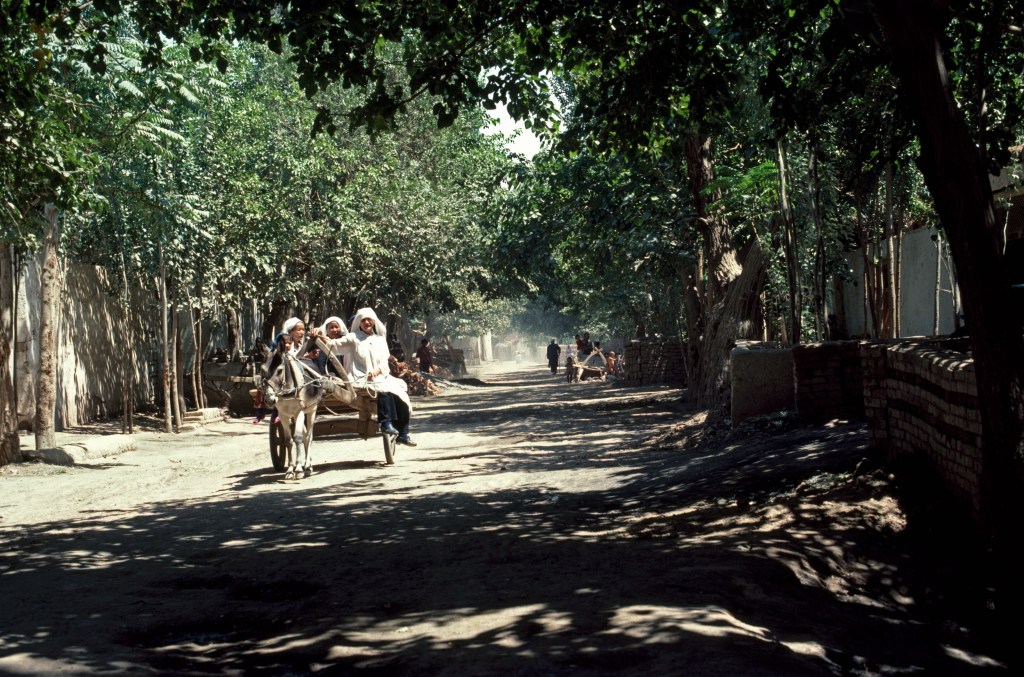
Another important characteristic of the vernacular house in Turpan was a construction technology based on sun-dried mud brick coupled with simple wood framing using the poplars – materials that were 100% organic, non-toxic, biodegradable, re-usable and required no fossil fuels for processing and transport. This was effective for two reasons: first, materials were available immediately to hand, inexpensive or free; second, the method of building was easily conveyed through an oral tradition of instruction and simple enough that just about anyone was capable of building their own house. As an architect, I was delighted to find myself in a town full of designers and builders of all ages enjoying the freedom to determine for themselves how they were to live.
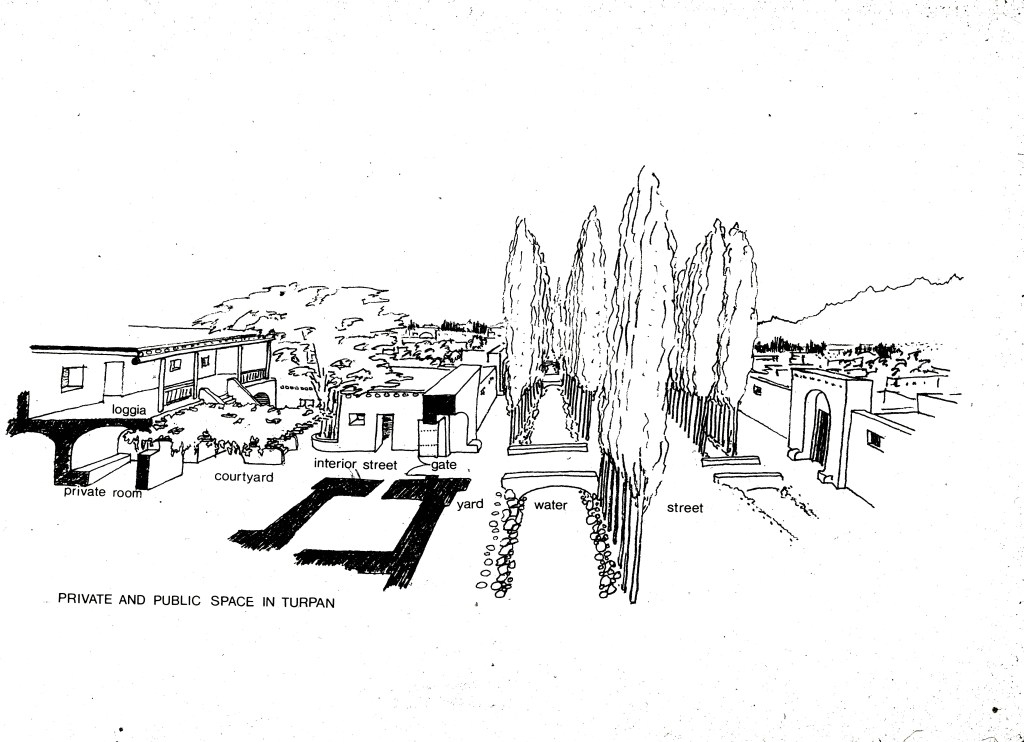
In addition to its entirely rational environmental attributes, the typical traditional house in Turpan served to organize and control social relations between members of the family it sheltered and the rest of the community. My study revealed a “privacy gradient” by which a sequence of simple spaces through the house and into the street produced a range of social settings in which people of varying relationships could interact informally or formally depending on circumstances or a person’s status in relation to the family. In this respect, the privacy provided by a house functioned in concert with the public life of the street rather than in opposition to it. There were eight social settings organized linearly in sequence: the public street; a short, wide bridge over the canal in front of the house; a narrow yard between the canal and the front wall of the house; a monumental gate that created a private room open to the street but separated from it by a canal; an interior street bounded by service spaces; the courtyard; a second floor mezzanine overlooking the courtyard; and finally the family’s entirely private interior spaces.
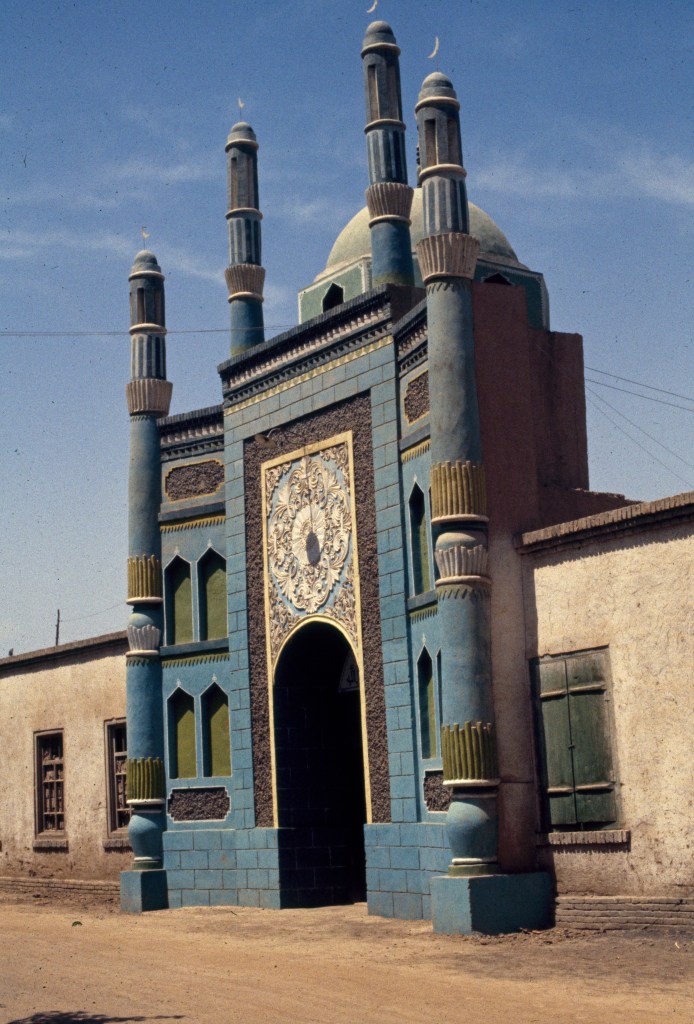
There were two types of mosques in Turpan: small ones serving neighborhoods and one large congregational mosque serving the entire community. Most of the small mosques vanished when the neighborhoods they served were destroyed. Similar to the one shown here, the neighborhood mosque typically employed an ornate entry gate on the street, then a narrow passage leading to a simple, often open-air prayer hall. Note in this example of a decorative gate, the plastered brick minarets marking the corners of the building have bases in the shape of pots. This motif harks back to the form of much older, extinct precedents in which the minarets were made of bundles of reeds. These were set in pots of water to protect them from insects. The ancient, traditional form in a fragile material persisted in a later durable material.
The monumental mosque of Turpan was the Amin Hodja Mosque built in 1776 and sited at the edge of town. The main body of the building is plastered brick while the 144-foot tower is exposed fired brick in a design typical of towers still to be found in Iran and Transoxiana. An interesting feature of this example is that it serves three purposes simultaneously. First, it can be used as a minaret from the top of which a muezzin would call the faithful to prayer; second, it is a tomb-tower marking the location of the tombs of its patron and his father at the base; and third, it may have been used as a lighthouse, since even a small fire at its top could have guided caravans to the oasis from many miles away. The main building also had a dual purpose. The size of its central hall suggests that it once accommodated a large congregation of worshipers while the surrounding cubic cells were used as a madrassa, or a koranic school, with boys to the right side and girls to the left. Curiously, the plan, with ranks of double cells surrounding an open center, is virtually the same as that for a typical caravanserai, which was a medieval fortified hostel for traveling merchants. A merchant would marshal his animals in a central, unroofed space and set up temporary housekeeping in one of the pair of peripheral cells – his baggage in the outside cell and his sleeping space facing the center space. Long ago, these hostels appeared at intervals of a one-day march along the entire Silk Road. Though this building was definitely intended as a mosque from its inception, it is interesting to see in the Islamic tradition how a particular plan type could accommodate different functions, in this case both religious and commercial. Though this beautiful building has not been destroyed, it was stripped of its religious function and insensitively “restored” to serve as a theme park requiring tourists to pay admission.
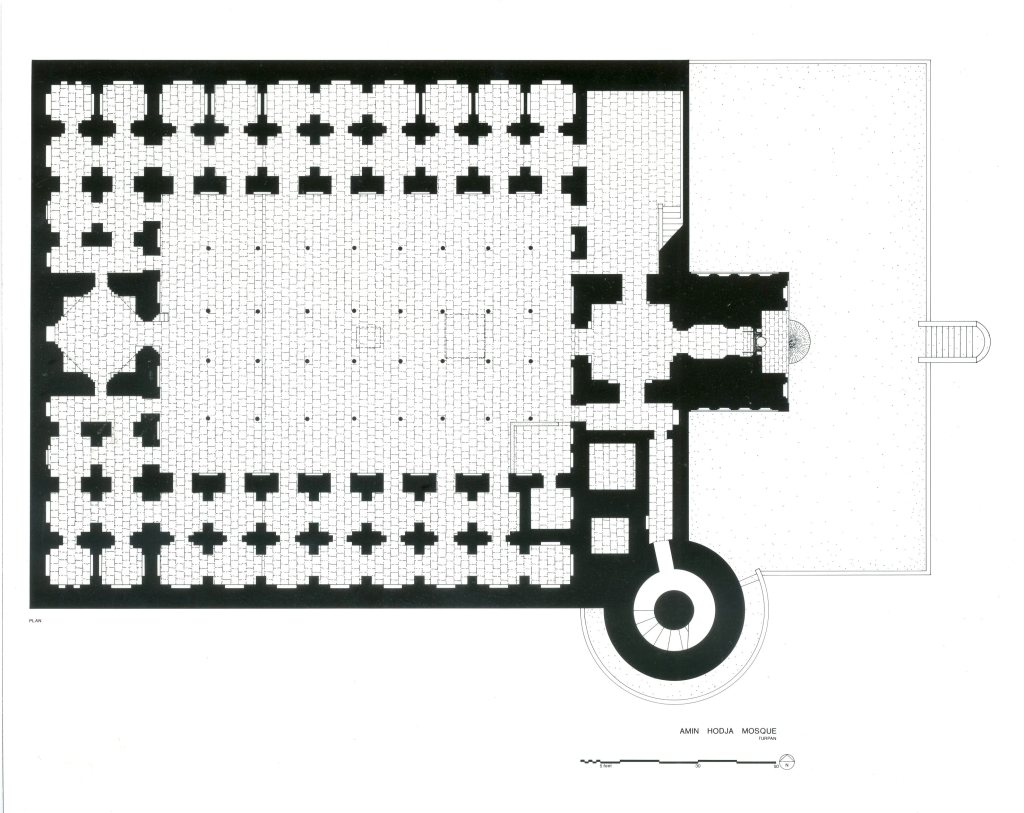
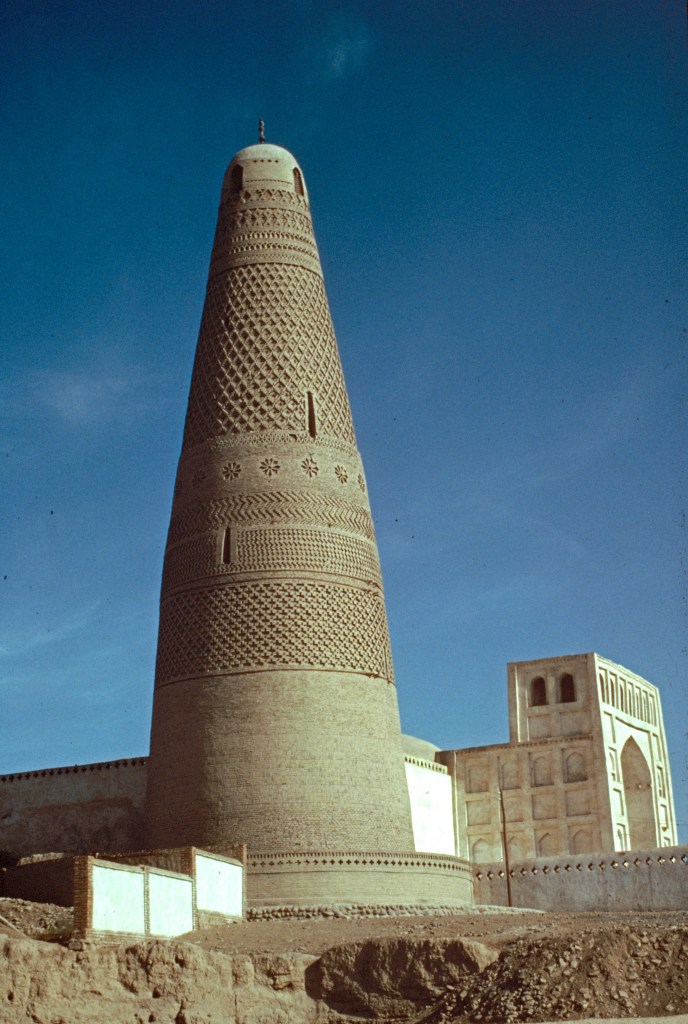
As we can readily see, the vernacular architecture of Turpan functioned as the physical armature of Uighur culture and a clear indicator of a durable, transparent social structure. The destruction of this architecture meant the fatal weakening of traditional social relations and finally the destruction society as a whole. It is clearly apparent that this was understood by the Chinese government as a means to eradicate the Uighur as a distinct ethnic group and institute a total surveillance state in Xinjiang province. In addition to other methods of control, destruction of mosques was critical to the suppression of Islam. Also, the systematic destruction the Uighur house, which served as the basic building block of urban civic life in Turpan, resulted in the destruction of the family unit, weakening the extended family, neighborhoods and broader communal relations.
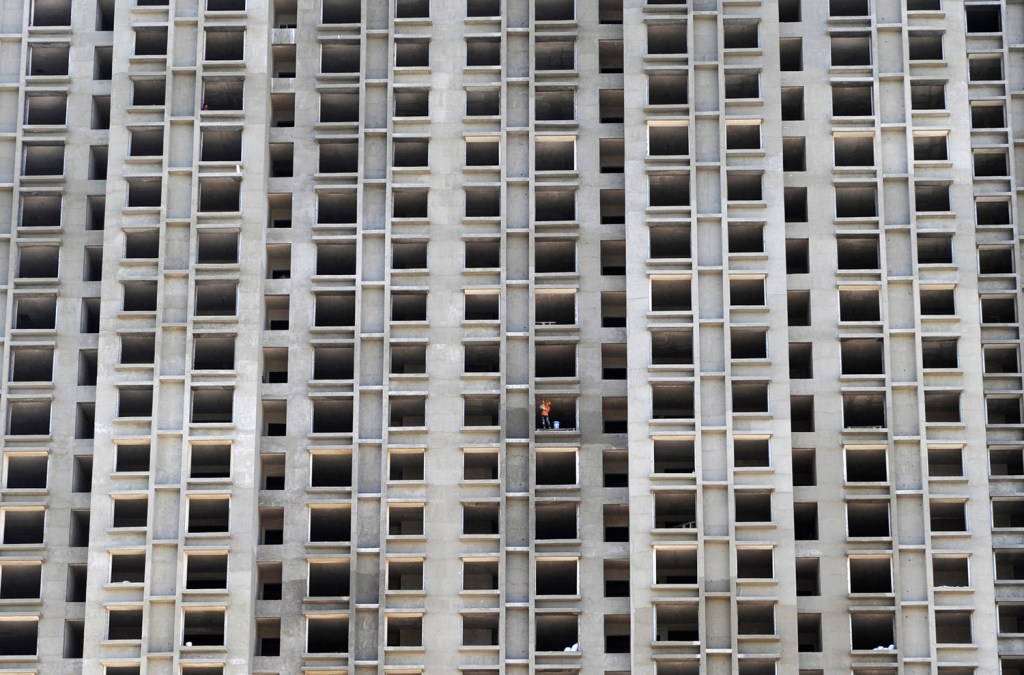
In the ruins of traditional neighborhoods, tall, impersonal concrete structures now rise, with hot, airless cells dependent on fossil fuels for ventilation and lighting. This act of ethnic cleansing eliminated the ability of the Uighur of Turpan to decide for themselves how to live by stripping them of their freedom to build. The result is the atomization of a community, reducing it to no more than alienated individuals, susceptible to manipulation and indoctrination and entirely reliant upon an alien regime that compels them to be obedient above all.
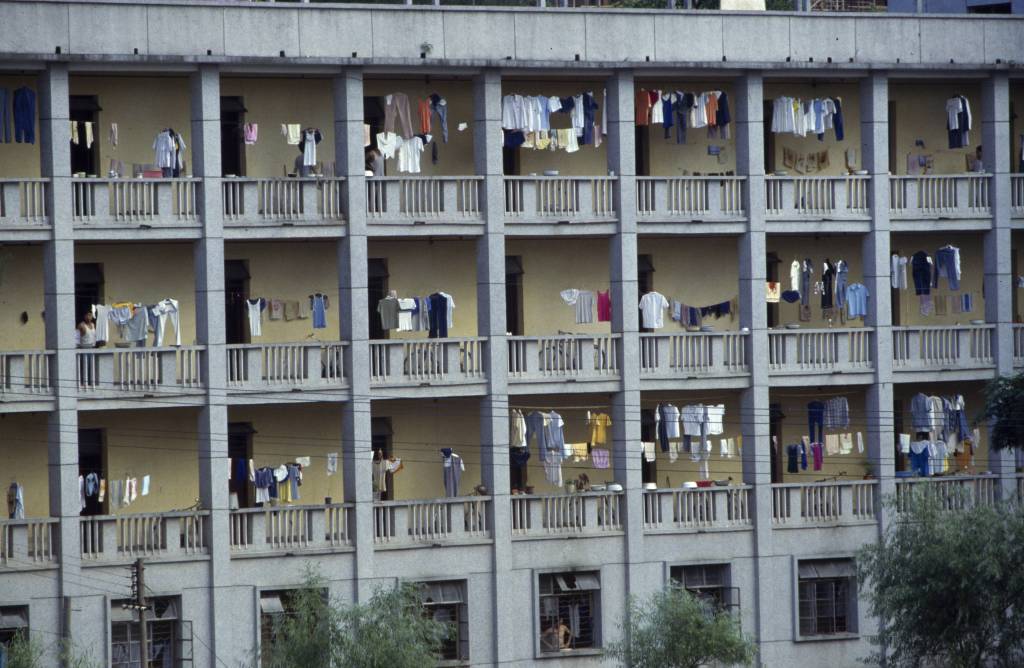
Last week Emeritus Professor Don Hanlon was the Academic Adventurers speaker at the AGS Library. The title of his talk “The Case of Turpan, China: How to Destroy a Culture” highlighted the village of Turpan and what has happened to it over the decades. He wrote this article as a guest blogger.
To view more of the nearly 300 photographs and sketches that Donald Hanlon recently donated to the AGS Library, visit the AGSL Digital Photograph Collection.
Chinese Propaganda Posters
by Sean Yan
Chinese propaganda posters were a product of the Chinese Communist Party in the twentieth-century, created to glorify the efforts of the party. The posters were also intended to reinforce harmony between citizens and the government. They can usually be found in newspapers, calendars and textbooks. Artists today are inspired by these posters to capture this period in history and at the same time, to show criticism. There is a growing popularity of the propaganda poster style among designers of home decor and apparel, and this style is especially popular with the younger generations in China.
It has been more than a year since I first came to the U.S. from China. Although I was born and raised much later than when the propaganda posters were most popular, there were still many propaganda poster elements in Chinese society in the 1990s. One of the first projects I worked on after being hired at the AGS Library was the scanning of about 21 of these propaganda posters. I was surprised to see these posters, which haven’t been seen for years in China, here in Milwaukee. It feels different to see this collection in the U.S because most of what I had seen was in elementary school textbooks.
The AGS Library has 21 posters in total and here are a few examples:
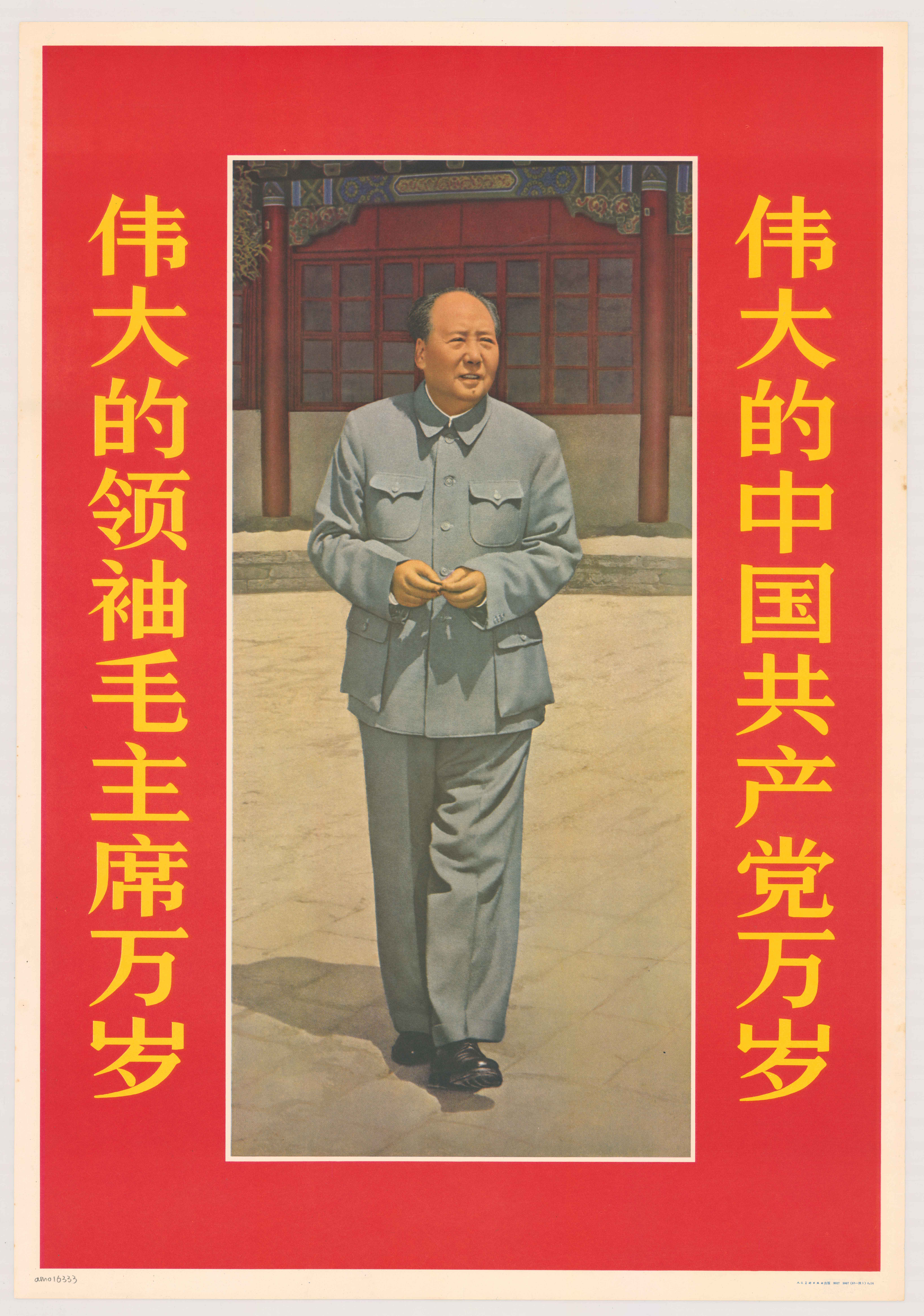
*Note: “Ten thousand years” is a phrase which expresses people’s worship of an emperor in ancient China, but it also can be used as a feeling of triumph. (There is a little bit of both in my personal view, the same for the other posters shown)
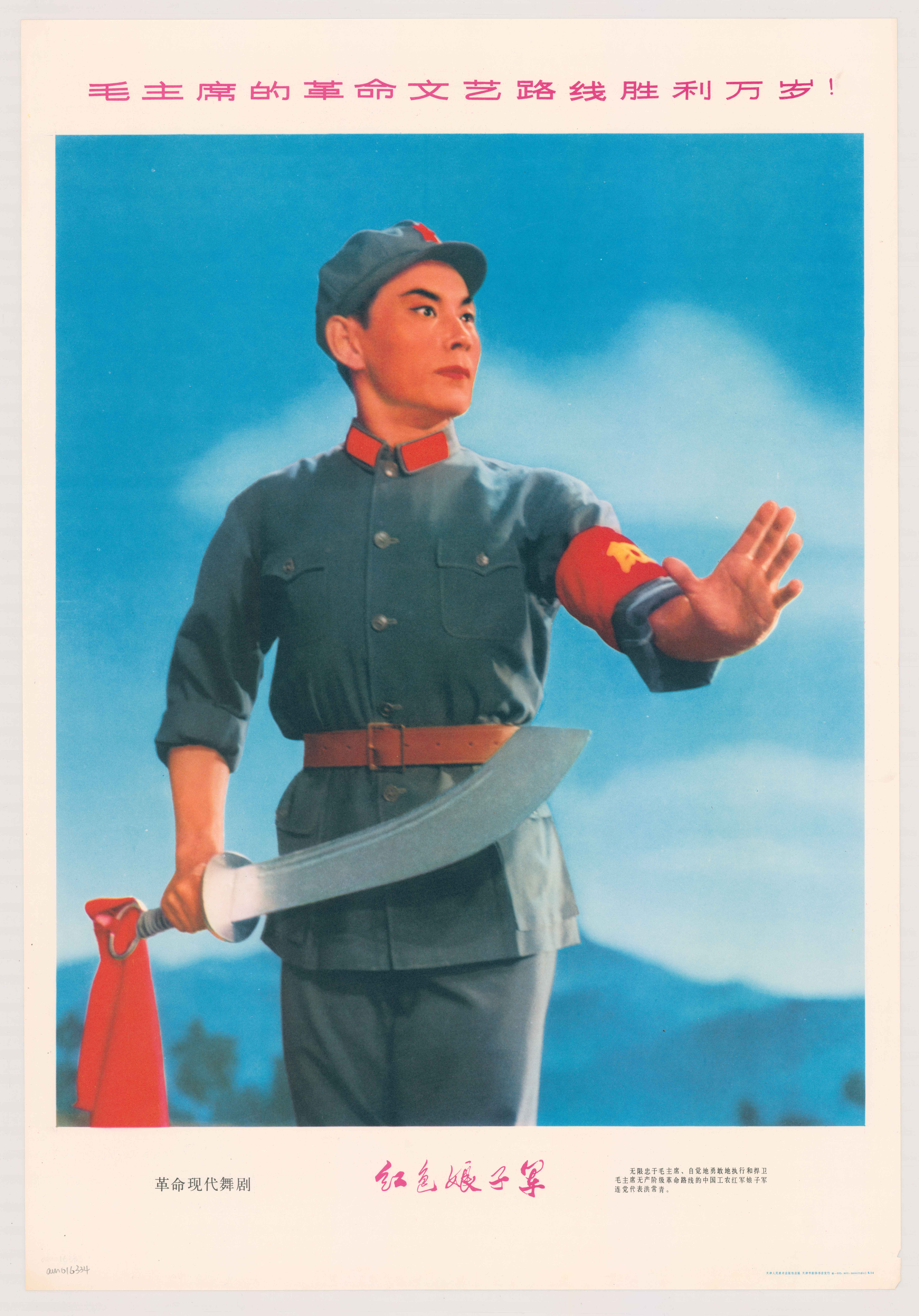
The poster above shows a character in contemporary ballet called “Red Detachment of Women (红色娘子军)” which is regarded as a masterpiece in modern China.
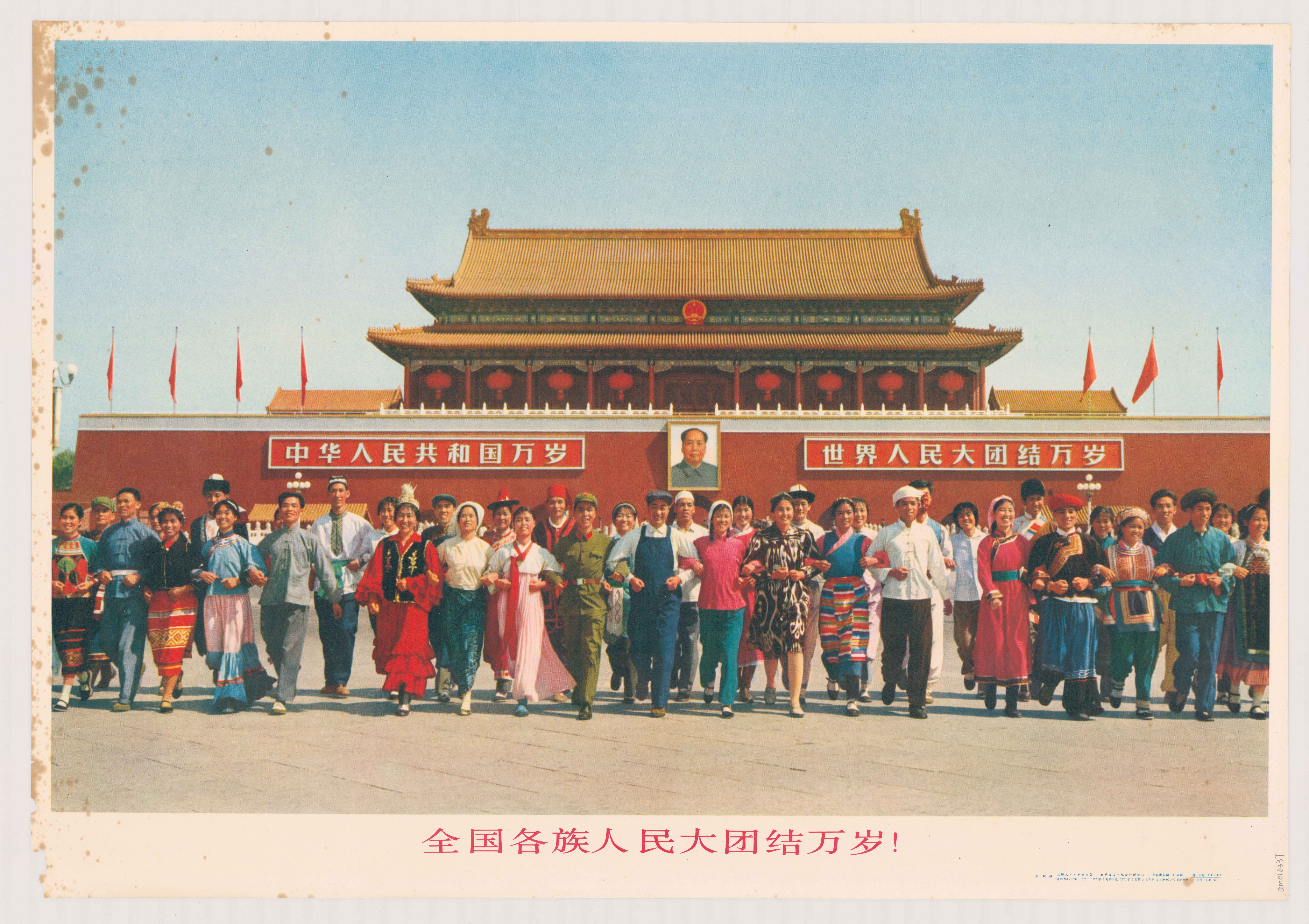
People in the poster above are standing in front of Tian’an Men, which is a national symbol of China. The poster stands for the unity of the 56 ethnicities of the entire nation. This is a very common image that you find in offices, homes and even some local government buildings.
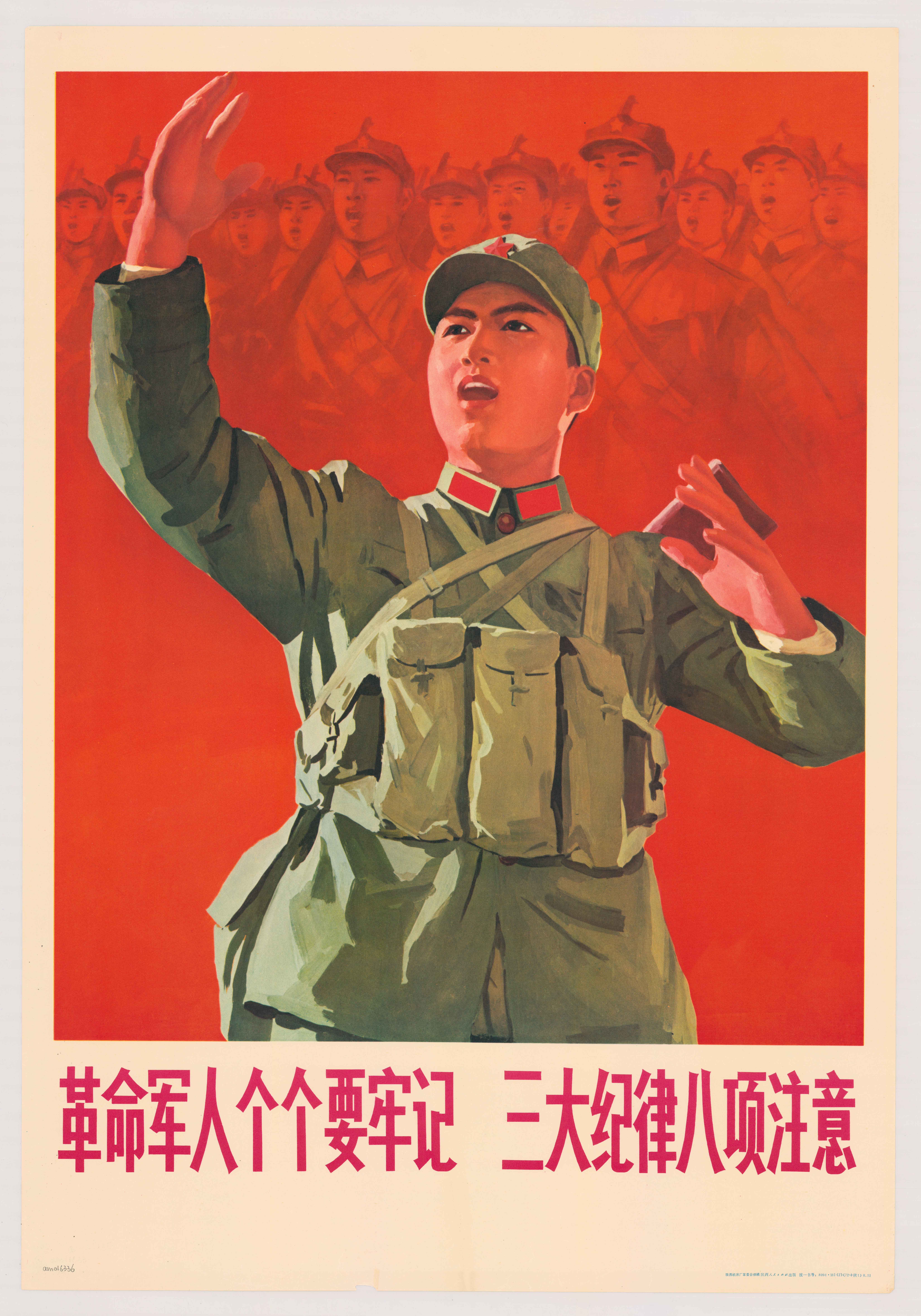
This poster reminds people of the “Military doctrine for the Chinese Red Army.”
The three rules are: 1. prompt obedience to orders; 2. no confiscation of people’s property; 3. turn in everything captured.
The eight points for attention are: 1. be polite when speaking; 2. be honest when buying and selling; 3. return all borrowed articles; 4. pay compensation for everything damaged; 5. do not hit or swear at others; 6. do not damage crops; 7. do not harass females; 8. do not mistreat prisoners.
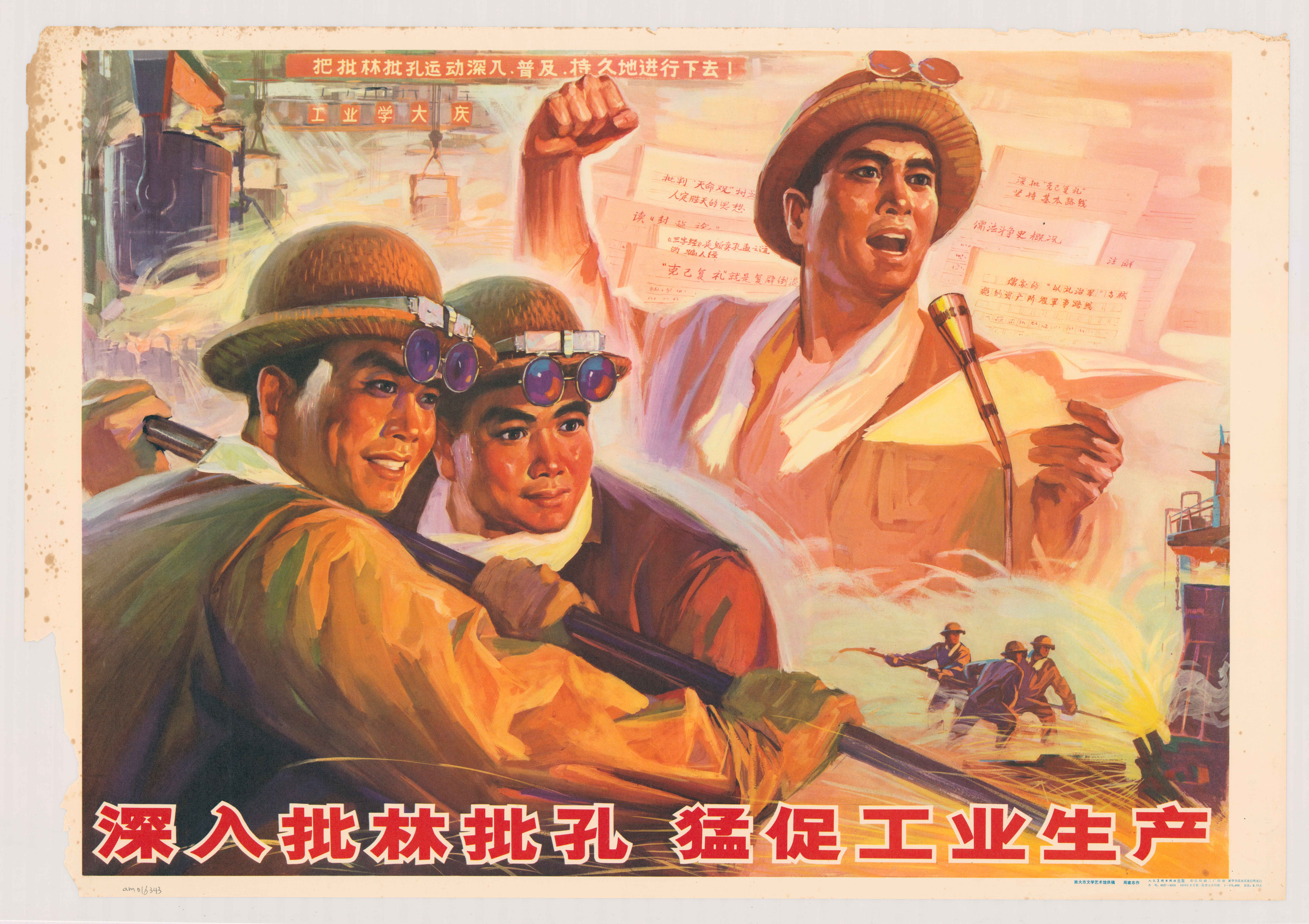
This poster is very representative of the great Cultural Revolution, started in 1966 and ended by 1976, which meant to reinforce Mao’s Communism by purging remnants of capitalist and traditional elements from Chinese society. “Lin” refers to Lin Biao who was the vice president of People’s Republic of China and “Kong (孔)” refers to Confucius. Due to Mao’s political theory, he encouraged the public to criticize Confucius, Confucianism and Lin who was officially condemned as a traitor by the Communist Party after a failed coup attempt against Mao.
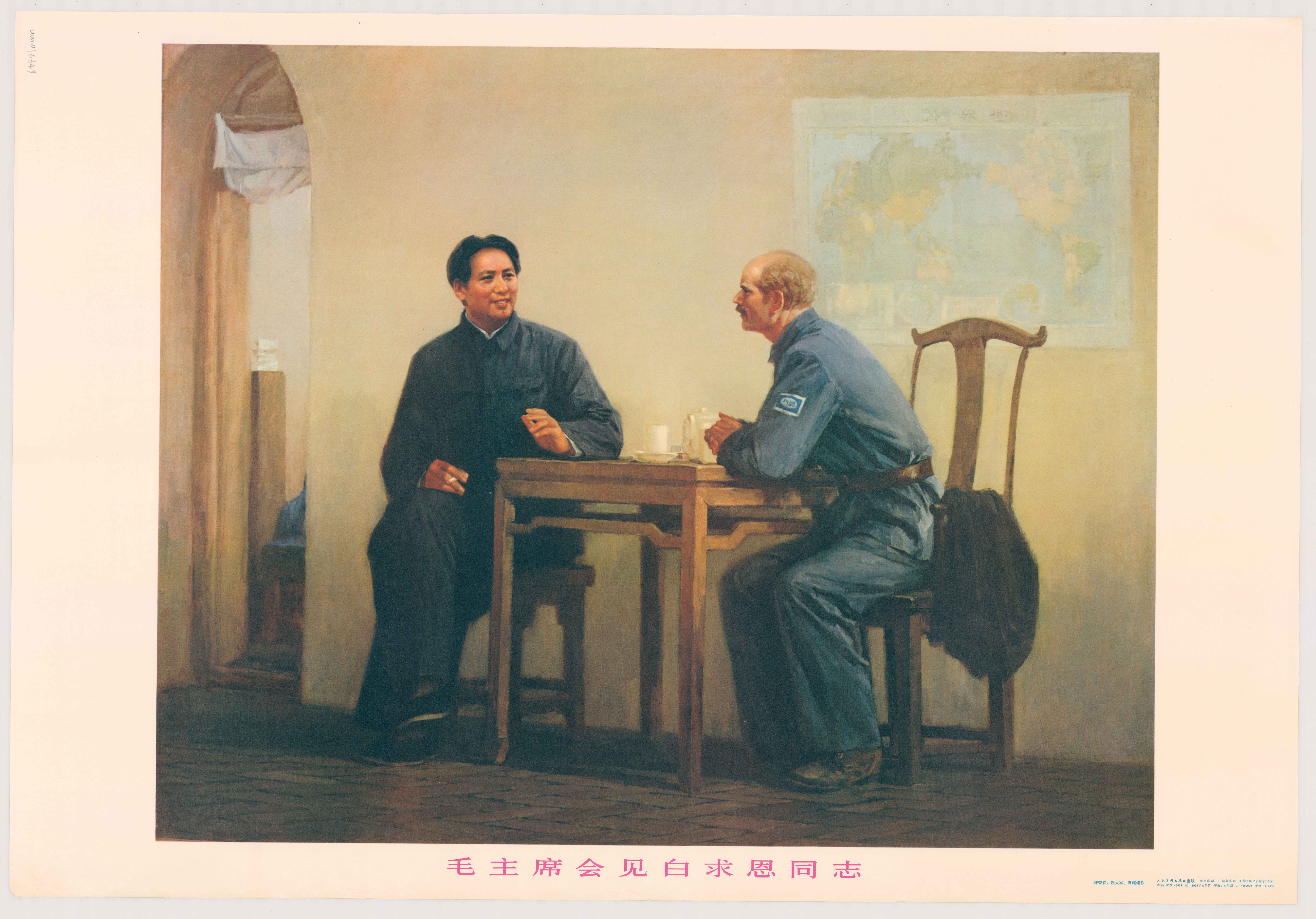
As a surgeon, Bethune greatly helped Eighth Route Army soldiers who had been wounded on the front line during the Second Sino-Japanese War that would earn him enduring acclaim. Dr. Bethune was greatly praised by Mao and has been included in school textbooks ever since.
You are more than welcome to leave any comments below in regards to Chinese propaganda posters or anything about China. Feel free to stop in and check out the rest of the posters and our collections at AGS Library 3rd floor, east wing of UWM Libraries.

